
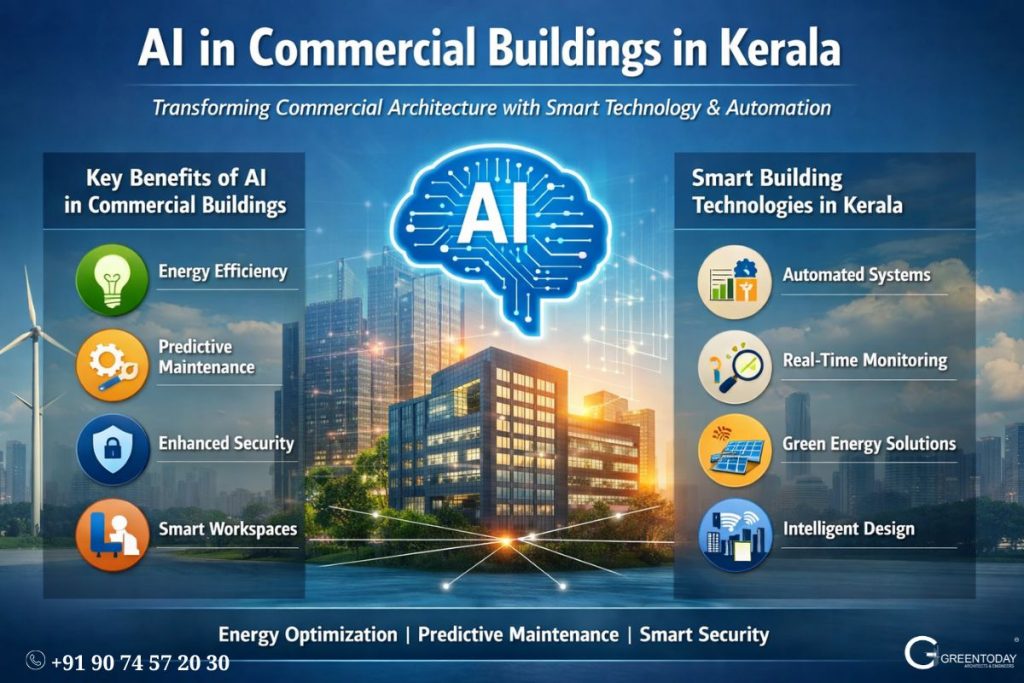
AI in Commercial Buildings in Kerala
AI in commercial buildings in Kerala is transforming modern architecture into intelligent, energy-efficient, and sustainable ecosystems, enabling smarter business environments and optimized building performance.
Introduction to AI and Automation in Commercial Buildings
The modern commercial building is no longer just a physical space; it is becoming an intelligent ecosystem. With rapid advancements in Artificial Intelligence and automation, commercial architecture is entering a new era where buildings can think, learn, and respond in real time. From energy optimization to predictive maintenance and enhanced occupant comfort, AI is transforming how commercial spaces are designed, constructed, and managed.
For businesses, this shift is not just about innovation; it is about efficiency, cost savings, sustainability, and creating environments that support productivity and well-being.
The Rise of Intelligent Commercial Buildings
Traditionally, building operations relied heavily on manual system maintenance. Today, AI-driven technologies allow commercial buildings to operate proactively. Sensors, data analytics, and automation systems work together to monitor everything from occupancy levels to energy usage.
Key Features of Intelligent Commercial Buildings:
- Adjust lighting and temperature automatically
- Detect equipment faults before failure
- Optimize space utilization
- Enhance security through intelligent surveillance
This transformation is redefining the role of commercial spaces—from static infrastructure to dynamic, responsive environments.
Energy Efficiency and Cost Optimization with AI
How AI Improves Energy Management in Commercial Buildings
One of the most significant contributions of AI in commercial buildings is energy management. Energy consumption is a major operational cost, especially in large office complexes, malls, and institutional buildings.
Key Benefits of AI-Based Energy Optimization:
- Regulate HVAC systems based on occupancy
- Optimize lighting through daylight sensors
- Reduce energy wastage during non-peak hours
- Predict energy demand patterns
This not only reduces operational expenses but also contributes to environmental sustainability by lowering carbon footprints.
Predictive Maintenance in Commercial Buildings
In traditional systems, maintenance is often reactive—problems are fixed only after they occur. AI enables predictive maintenance, in which systems anticipate failures before they happen.
Real-World Applications of Predictive Systems:
- Elevators can signal wear and tear before a breakdown
- HVAC systems can identify inefficiencies early
- Electrical systems can detect irregularities and prevent hazards
This approach reduces downtime, extends equipment lifespan, and minimizes repair costs, ensuring smoother business operations.
Enhancing Workplace Productivity with Smart Environments
Commercial buildings are designed to support human activity, and AI plays a crucial role in improving occupant experience.
Smart Features That Boost Productivity:
- Adjust temperature and lighting for comfort
- Monitor indoor air quality
- Manage noise levels
- Optimize workspace allocation
By creating healthier and more comfortable environments, AI contributes directly to employee productivity and satisfaction, an important factor for modern businesses.
Intelligent Security and Safety Systems in Commercial Buildings
Security in commercial buildings has evolved significantly with AI integration. Advanced systems now use facial recognition, behavior analysis, and real-time alerts to enhance safety.
Advanced Safety Features Enabled by AI:
- Smart surveillance cameras with threat detection
- Automated access control systems
- Emergency response automation
- Fire detection and evacuation optimization
These systems not only improve safety but also reduce the need for constant manual monitoring.
Space Optimization and Smart Work Environments
With the rise of hybrid work models, commercial spaces must be flexible and efficient. AI helps businesses understand how spaces are used and how to optimize them.
How AI Optimizes Space Utilization:
- Identify underutilized areas
- Optimize seating arrangements
- Improve meeting room usage
- Reduce unnecessary space costs
This ensures that commercial buildings remain relevant and adaptable to changing work patterns.
Automation in Construction and Design
AI is not limited to building operations—it is also transforming the construction phase of commercial projects.
Benefits of Automation in Design and Execution:
- Faster and more accurate design processes
- Digital simulations for performance analysis
- Efficient project scheduling
- Reduced material wastage
Advanced planning systems ensure that buildings are not only intelligent in operation but also efficient in construction.
Sustainability and Green Building Integration in Kerala
AI and automation are key enablers of sustainable commercial architecture. By continuously analyzing environmental data, smart systems ensure optimal use of resources.
Environmental Benefits of Smart Buildings:
- Reduced energy consumption
- Efficient water management
- Integration of renewable energy systems
- Lower greenhouse gas emissions
For regions like Kerala, where climate responsiveness is essential, AI-driven buildings can significantly improve environmental performance.
Growth of Smart Commercial Buildings in Kerala
Emerging Trends in Cities like Kochi, Trivandrum, and Kozhikode
Kerala is witnessing a steady shift toward smarter commercial infrastructure, especially in cities like Kochi, Trivandrum, and Kozhikode. Businesses are increasingly looking for buildings that offer efficiency, sustainability, and technological integration.
Challenges and Considerations in Implementing AI
Key Challenges in AI Integration
While AI offers immense benefits, its implementation requires careful planning:
- Initial investment costs can be high
- Integration of systems requires technical expertise
- Data privacy and cybersecurity must be addressed
- Regular updates and maintenance are essential
However, the long-term benefits far outweigh these challenges, making AI a worthwhile investment for commercial projects.
The Future of AI in Commercial Buildings
The next generation of commercial buildings will be even more advanced, featuring:
- AI-driven digital twins for real-time monitoring
- Fully automated building management systems
- Self-learning environments that adapt continuously
- Integration with smart city infrastructure
Buildings will evolve into living systems that interact seamlessly with occupants and the surrounding environment.
AI in Commercial Buildings in Kerala
For those envisioning AI in Commercial Buildings in Kerala and automation-driven commercial spaces, GreenToday Infrastructure stands out as a dependable and forward-looking partner in Kerala’s architectural and construction landscape. With over a decade of proven expertise, the firm has built a strong reputation for delivering structures that are robust, refined, and performance-driven—where structural strength is seamlessly paired with striking design.
The company’s portfolio reflects both diversity and depth, spanning premium villas, modern apartment developments, commercial complexes, educational institutions, and large-scale government projects. Each assignment is approached with a clear emphasis on innovation, engineering accuracy, and long-term value, ensuring that every structure remains relevant and resilient over time, both functionally and visually.
At the core of this vision is the leadership of Faizal M. Asan, a highly experienced senior civil engineer with extensive exposure across India and the Middle East. His guidance brings together technical precision, disciplined execution, and a strong commitment to structural excellence, ensuring that every project is thoughtfully planned and expertly delivered.
GreenToday Infrastructure offers a comprehensive, end-to-end service model that covers every phase of development. From initial land evaluation and soil analysis to architectural design, construction, interior and exterior detailing, and advanced automation integration, each step is handled with care and coordination. A defining strength of the firm lies in its commitment to sustainability by integrating biophilic design principles, eco-friendly materials, and solar-responsive strategies to create spaces that are energy-efficient, environmentally sensitive, and comfortable to inhabit.
The company’s approach to interiors goes beyond aesthetics. Every space is designed to perform, evolve, and endure. Multi-functional interiors are shaped through a thoughtful blend of human-centric planning, climate-responsive strategies, sustainable material selection, integration of future-ready technologies, and a timeless design language. This ensures that interiors remain intuitive, adaptable, and meaningful, aligning with the changing needs of modern living and working environments.
By maintaining global standards and adhering to strong ethical practices, GreenToday Infrastructure ensures uncompromising quality across all projects. Its consistent focus on innovation, sustainability, and engineering excellence continues to elevate architectural benchmarks across Kerala.
For clients who aspire to build with clarity of vision, responsibility, and refined sophistication, GreenToday Infrastructure offers more than just construction expertise—it delivers transformative, future-ready spaces that redefine how architecture is experienced and lived.
GreenToday Infrastructure is incorporating AI-driven planning, smart automation, and energy-efficient design strategies into commercial projects. By aligning global technological trends with local environmental needs, such firms are helping shape the future of commercial architecture in the region.
AI and automation are redefining commercial buildings, transforming them into intelligent, efficient, and sustainable environments. From reducing operational costs to enhancing user experience and supporting environmental goals, these technologies are shaping the future of business infrastructure.
For developers, investors, and business owners, embracing AI is no longer optional—it is a strategic move toward long-term success. As commercial architecture continues to evolve, intelligent buildings will stand at the forefront, setting new standards for performance, innovation, and sustainability.

Corporate Address
GreenToday Infrastructure
4 B Arcade, Infopark Road, Kusumagiri P.O, Kakkanad- Ernakulam, Kerala – 682030 India
Branch Address
GreenToday Infrastructure
Peedikayil Building
Cochin Bank Jn
Aluva, Ernakulam, Kerala – 683101
Registered Address
GreenToday Infrastructure
‘Breeze ‘
Pattimattom PO 683562 Ernakulam Kerala India
Our Hours
- Monday — Friday 9 am – 5 pm
- Saturday — 9 am – 4 pm
- Sunday — Closed
Service Areas
Contact Us
Follow Us
All rights reserved by GreenToday Infrastructure
Maintained by www.irisqtechnologies.com