
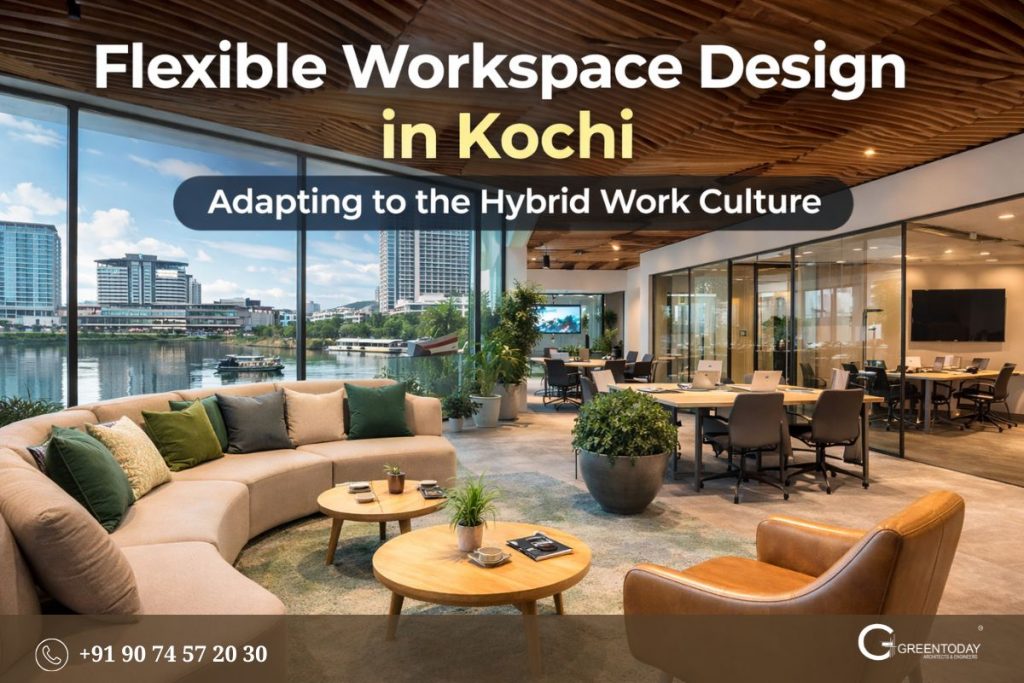
Flexible Workspace Design in Kerala – Adapting to the Hybrid Work Culture
The way, the pattern, and the setting of how we work have undergone a fundamental transformation. Traditional office environments, once defined by fixed desks and rigid layouts, are giving way to flexible, adaptive workspaces that respond to the evolving needs of businesses and employees. The rise of hybrid work—where teams split time between office and remote locations—has reshaped commercial architecture, demanding spaces that are dynamic, efficient, and people-centric. Flexible Workspace Design in Kerala is no longer a trend; they are the future of commercial design.
The Shift from Fixed Offices to Hybrid Environments
The Shift from Fixed Offices to Hybrid Environments
For decades, offices were designed for permanence—assigned seating, enclosed cabins, and standardized layouts. However, the hybrid work culture has introduced a new reality where not every employee is present at the same time.
This shift has led to:
- Reduced need for fixed workstations
- Increased demand for collaborative spaces
- Greater emphasis on flexibility and adaptability
A focus on employee experience rather than just space utilization
Modern workspaces must now accommodate a variety of activities—focused work, team collaboration, virtual meetings, and informal interactions—all within a single environment.
What Defines a Flexible Workspace?
A flexible workspace is designed to adapt easily to different functions and user needs. It is not just about movable furniture but about creating an ecosystem that supports multiple ways of working.
Key features include:
Multi-Functional Zones
Spaces are divided into zones for different activities—quiet work areas, collaboration hubs, meeting rooms, breakout spaces, and informal lounges.
Hot Desking and Shared Spaces
Instead of assigned desks, employees use available workstations as needed, optimizing space usage and reducing costs.
Modular Design
Movable walls, foldable partitions, and reconfigurable furniture allow spaces to be transformed quickly.
Technology Integration
Smart systems support seamless communication, remote collaboration, and automation of lighting, climate, and security.
Enhancing Productivity and Employee Well-being
Flexible workspaces are designed with people at the center. By offering choice and comfort, they improve both productivity and satisfaction.
Enhancing Productivity and Employee Well-being
Flexible workspaces are designed with people at the center. By offering choice and comfort, they improve both productivity and satisfaction.
Benefits of Flexible Workspaces:
- Better focus through dedicated quiet zones
- Increased collaboration through open layouts
- Reduced stress with a comfortable and ergonomic design
Improved work-life balance through adaptable environments
When employees can choose how and where they work, performance and engagement naturally improve.
The Role of Technology in Hybrid Workspaces
Technology is the backbone of flexible work environments. Smart office systems ensure that physical and digital workspaces are seamlessly connected.
Key technologies include:
- Video conferencing and collaboration tools
- Occupancy sensors and space analytics
- Smart booking systems for desks and meeting rooms
- Automated lighting and climate control
These tools enable efficient space management while enhancing user experience.
Space Optimization and Cost Efficiency
One of the biggest advantages of flexible workspaces is efficient space utilization. Businesses can reduce their real estate footprint without compromising functionality.
Through smart design and data-driven insights:
- Underutilized areas are minimized
- Space is allocated based on actual usage
- Operational costs are reduced
- Scalability becomes easier
This makes flexible workspaces a financially smart solution for modern businesses.
Sustainability and Smart Design
Flexible workspaces also support sustainable architecture. By optimizing space and integrating energy-efficient systems, they reduce environmental impact.
Sustainable features include:
- Natural lighting and ventilation
- Energy-efficient lighting systems
- Eco-friendly materials
- Reduced construction waste through modular design
These elements align with global sustainability goals while creating healthier work environments.
The Growing Trend in Kerala
Kerala is witnessing a steady transition toward a hybrid work culture, especially in cities like Kochi and Thiruvananthapuram. Businesses are increasingly looking for office spaces that are adaptable, technology-enabled, and environmentally responsible.
Designing for the Future
As hybrid work continues to evolve, the demand for flexible workspaces will only grow. Future office environments may include:
- Fully adaptive layouts powered by AI
- Personalized workstations that adjust to user preferences
- Integrated wellness features
- Seamless digital-physical work integration
- Spaces that evolve in real time based on usage patterns
These innovations will transform offices into intelligent ecosystems that support both business goals and human well-being.
Conclusion
Flexible workspaces represent a significant shift in commercial architecture, driven by the changing nature of work itself. By combining adaptability, technology, and human-centric design, these spaces offer a smarter, more efficient way to work.
For businesses, investing in flexible workspace design is not just about keeping up with trends—it is about staying competitive in a rapidly changing world. As hybrid work becomes the norm, the offices of the future will be those that can adapt, evolve, and inspire.
Why Choose GreenToday Infrastructure for Flexible Workspace Design in Kerala
If you’re seeking adaptable workspaces that align with today’s hybrid work culture, GreenToday Infrastructure offers the expertise and reliability you can depend on. Recognized for delivering excellence in both architectural design and construction, the firm creates spaces that are visually compelling, highly functional, and built with the future in mind.
The portfolio of GreenToday Infrastructure spans a wide spectrum, from refined private villas and modern apartments to vibrant commercial developments and tranquil resort environments. Each project is thoughtfully conceived, blending design creativity with skilled craftsmanship and contemporary innovation. Every phase is guided by careful planning, including detailed geotechnical assessments, integrated architectural solutions, and precision-driven construction methods. Their work embraces biophilic design, sustainable building practices, smart automation technologies, and strong safety frameworks.
Quality and integrity remain at the core of every project undertaken. With a strong focus on transparency, strict quality standards, and ethical execution, GreenToday Infrastructure consistently delivers beyond expectations. The firm goes beyond the role of a conventional builder, positioning itself as a long-term partner by offering a one-year comprehensive warranty along with lifetime support—ensuring continued confidence and satisfaction.
GreenToday Infrastructure incorporates flexible design principles, smart technologies, and climate-responsive architecture into commercial projects. By blending global workplace trends with local environmental considerations, they are helping redefine the future of office spaces in the region.
More than just constructing buildings, GreenToday Infrastructure creates purposeful spaces, promotes sustainability, and leaves behind architectural legacies that stand the test of time.

Corporate Address
GreenToday Infrastructure
4 B Arcade, Infopark Road, Kusumagiri P.O, Kakkanad- Ernakulam, Kerala – 682030 India
Branch Address
GreenToday Infrastructure
Peedikayil Building
Cochin Bank Jn
Aluva, Ernakulam, Kerala – 683101
Registered Address
GreenToday Infrastructure
‘Breeze ‘
Pattimattom PO 683562 Ernakulam Kerala India
Our Hours
- Monday — Friday 9 am – 5 pm
- Saturday — 9 am – 4 pm
- Sunday — Closed
Service Areas
Contact Us
Follow Us
All rights reserved by GreenToday Infrastructure
Maintained by www.irisqtechnologies.com